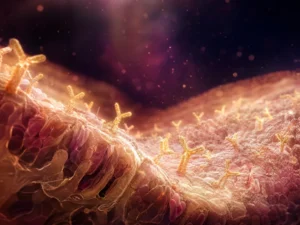

We keep hearing it: “Strengthen your immune system.” But a stronger immune system is not automatically a better one. Allergies and autoimmune conditions show that the body’s defences can also do too much. What they need is something else: judgement. There is a term we use in our work for exactly that: immune intelligence.
What is immune intelligence?
Immune intelligence describes how wisely your immune system works. For me, four abilities belong to it:
- Recognising: telling what is threatening from what is harmless, that is, pathogens from pollen, food or the body’s own tissue.
- Responding proportionately: as strongly as necessary and as gently as possible.
- Remembering: keeping what has been learned, so that the next encounter is faster and more targeted.
- Calming down: once the danger has passed, turning the defences back down.
To be honest: immune intelligence is not an established technical term in immunology. Science speaks of recognition, regulation, immunological memory and tolerance. The phrase simply sums up what this is really about: not strength, but intelligence. The term was coined by my friend Dr. Angels Muñoz.
How does the immune system recognise a threat, and how does it remember?
Your body defends itself on two levels. The innate defence is fast and responds within minutes to hours to anything that seems foreign. The acquired defence takes longer but works with great precision: B and T cells get to know a specific pathogen, and some of them stay on as memory cells. That way your body does not have to start from zero the next time.
The two levels talk to each other constantly, through small messenger molecules called cytokines. It is a conversation, not a chain of command. How closely that conversation is linked to your hormones is something I described in the article on hormones and the immune system.
Is a stronger immune system always a better one?
No. With hay fever, the immune system reacts to pollen that is completely harmless. In autoimmune conditions it turns against the body’s own tissue. In both cases the defence is not too weak but poorly informed.
Persistent low-grade inflammation belongs here too. In later life, researchers call it inflammaging and describe it as one of the more consistent threads in ageing research (Franceschi et al., 2000). Inflammation in itself is not a bad thing. It is the immune system’s answer to a challenge, and in the short term it makes sense, for example after an injury or an infection. It becomes tricky when it never ends: when stress, lack of sleep or other burdens keep the defences under constant demand and they receive no clear signal that the job is done. Regulation then turns into permanent alarm. So anyone who wants to support their immune system does better to ask: does this help my immune system work more wisely? And not: does this make it do more?
How does an immune system learn, and can that knowledge be passed on?
Nature has its own solution for this. A newborn has had no time to gather immune experience. In mammals it therefore gets a head start from its mother, through the placenta and, in the first days, through colostrum, the first milk. Among other things it contains secretory IgA, which protects the mucous membranes (Playford and Weiser, 2021). You can read more in the article on IgA, the antibody that protects everything.
Birds pass antibodies on through the egg yolk (Hamal et al., 2006). Overall, the route via placenta, yolk or milk is widespread among vertebrates (Hasselquist and Nilsson, 2009).
As early as 1955, Henry Sherwood Lawrence showed that an extract of white blood cells can transfer a specific immune reaction from one person to another (Lawrence, 1955). The small information carriers I call Intelligent Molecules come from this line of research. You can find out how they are described on the Intelligent Molecules page.
What influences immune intelligence in everyday life?
Your immune system is not an isolated organ. It is in constant exchange with your nerves, hormones and surroundings. Research finds links with, among others, these areas:
- Stress: chronic stress and persistently raised cortisol change immune regulation. You can read how to build stress resilience in the article From Stressed to Stress Resilient.
- Connection with other people: social isolation and loneliness are linked with a higher risk of death (Holt-Lunstad et al., 2015). According to current understanding, part of this runs through inflammatory processes. More on this: Why Human Connection Is an Immune Health Strategy.
- Mucous membranes and gut: a large part of the immune defence is located here, with IgA as the first line of defence.
- Sleep, movement and nutrition: they are the foundation that nothing else replaces.
None of this means complicated rules. It means small steps that prepare the ground for regulation: regular sleep times, regular movement in fresh air, deliberate breaks during the day and real conversations with people who do you good. Nothing about it is spectacular. But these are exactly the signals an immune system can orient itself by.
Your immune system does not need to get louder. It may work more wisely, and you can give it the information and conditions it needs to do so. This is not a question of perfection but of attention. If you would like to know where you stand right now, the free Immune Intelligence Self-Assessment can help: seven questions, about three minutes.
With love and positivity,
Jennifer🙏🏻💛
General health information. It does not replace medical advice, diagnosis or treatment.